Travel from Vienna to Salzburg via Wachau
Vienna and Salzburg are two of Austria’s most popular destinations. While Vienna is known for its imperial architecture, museums and classical music, Salzburg offers a very different atmosphere: a compact historic city surrounded by mountains, shaped by Mozart, Baroque architecture and the story of The Sound of Music.
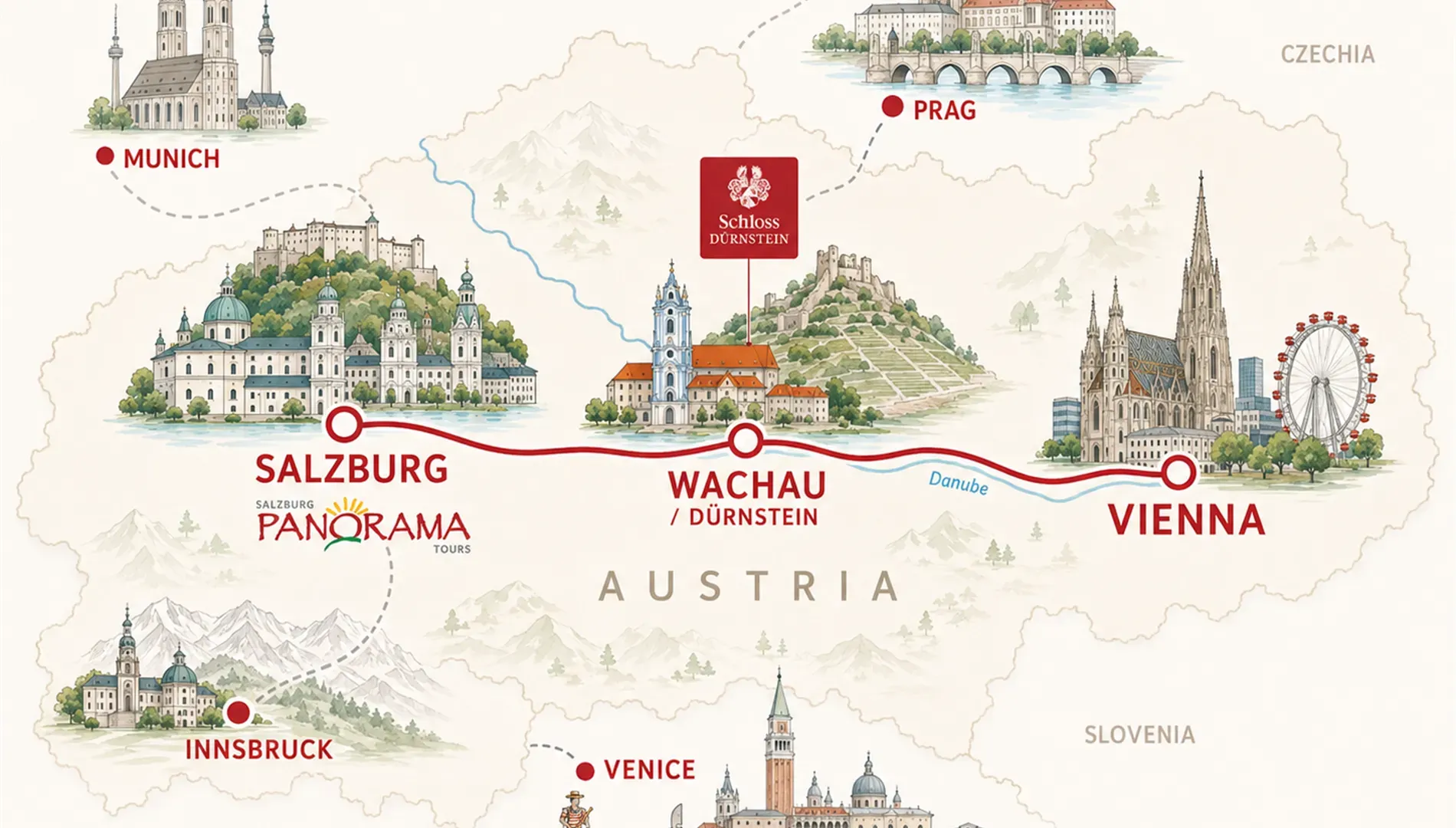
Travelers connecting the two cities often focus mainly on reaching their next destination. However, the route between Vienna and Salzburg also passes close to one of Austria’s most distinctive landscapes: the Wachau Valley.
The Wachau Valley stretches along the Danube between Krems and Melk. Dürnstein lies in the eastern part of the valley, around one hour from Vienna by car.
For travelers continuing west toward Salzburg, the Wachau is located close to the main route across Austria. A stay or short stop in Dürnstein can therefore be included without fundamentally changing the direction of the journey.
From the Wachau, Salzburg can usually be reached by car in approximately two and a half hours, depending on traffic and the exact starting point. Melk and the main east-west connections are easily accessible from the valley.
This makes the region suitable for travelers who prefer to divide the journey between Vienna and Salzburg into several stages rather than covering the entire distance at once.
Salzburg lies close to the German border and is surrounded by the foothills of the
Alps. Its
historic centre is a UNESCO World Heritage Site and can be explored comfortably on foot.
The city is closely associated with Wolfgang Amadeus Mozart, who was born in Salzburg in 1756. His birthplace on Getreidegasse and the Mozart Residence on Makartplatz are among the city’s best-known cultural attractions.
Above the old town,
Hohensalzburg Fortress provides views across the city, the
Salzach River and the surrounding mountains. Other
prominent landmarks include Salzburg Cathedral, Mirabell Palace and Gardens, St. Peter’s Abbey and the narrow streets around Getreidegasse.
Salzburg is also internationally known as one of the main locations connected with The Sound of Music. Several
scenes from the movie were shot in and around the city, including locations at Mirabell Gardens, Leopoldskron Palace and Hellbrunn. A particular highlight is the
Original Sound of Music Tour, operated by
Salzburg Panorama Tours which visits many of the locations daily and immerses visitors in the world of the Trapp family.
Book a Tour
Beyond the historic centre, Salzburg is a useful starting point for excursions into the surrounding lake and mountain regions. The Salzkammergut, Berchtesgaden, the Untersberg mountain and the lakes east of the city can all be reached on day trips.
- The Original Sound of Music Tour: For movie fans and travelers looking to combine city sightseeing with the surrounding countryside, this 4-hour guided coach tour takes you to iconic filming locations in and around Salzburg. A great way to take in both historical trivia and scenic alpine vistas while listening to the classic soundtrack.
- Fortress Hohensalzburg: Dominating the city skyline atop the Mönchsberg hill, this 11th-century castle is one of the largest preserved medieval fortresses in Europe. Ride the funicular to the top for 360-degree panoramic views over the Baroque city and the surrounding Alps.
- Mirabell Palace & Gardens: Built in 1606 by Prince-Archbishop Wolf Dietrich, these manicured Baroque gardens offer some of the best photo spots in Salzburg. It also became famous as a central setting in The Sound of Music where Maria and the children sing "Do-Re-Mi" around the Pegasus Fountain.
- Historic Old Town: Salzburg's UNESCO World Heritage historic center is packed with narrow medieval alleyways, grand squares, and historic shop facades. Walk down Getreidegasse to admire the traditional wrought-iron guild signs and visit Mozart's Birthplace. Enjoy local coffee culture at historic cafes scattered throughout the cobblestone streets.
- Salzburg Cathedral: Located in the heart of the Old Town, this impressive 17th-century Baroque cathedral is a masterpiece of sacred architecture. Features a striking marble facade, massive twin spires, and a dramatic interior dome. It houses the original Romanesque baptismal font where Wolfgang Amadeus Mozart was baptized.
Combining Vienna, Wachau and Salzburg gives travelers the opportunity to experience contrasting Austrian landscapes.
The Wachau is characterized by the
Danube, terraced vineyards, small riverside communities and a long tradition of fruit and wine growing. Salzburg, by contrast, is shaped by its
Alpine surroundings, Baroque cityscape and musical heritage.
In
spring, the Wachau is known for its
apricot blossom, when orchards across the valley turn white and pale pink. During summer, cycling paths, hiking routes and boat trips provide different ways to explore the Danube landscape.
Salzburg is particularly lively during the warmer months, when cafés, squares and gardens become part of everyday city life. The
Salzburg Festival also brings opera, theatre and classical music performances to venues throughout the city.
During winter,
Salzburg’s Christmas markets and snow-covered surroundings create another reason to include the city in a longer journey through Austria.
Dürnstein is one of the most recognizable towns in the Wachau. Its blue-and-white abbey tower, narrow historic streets and castle ruins above the village form part of the region’s characteristic scenery.
The town is also associated with
Richard the Lionheart, who was held captive at Dürnstein Castle during the late 12th century. The ruins of the medieval castle can still be visited today.
Travelers can spend a few hours walking through the village, following a section of the riverside path or visiting the surrounding vineyards. Those with more time may choose to stay overnight before continuing toward Salzburg the following morning.
Hotel Schloss Dürnstein is located directly above the Danube in the historic center of the town. As a former noble residence, it reflects the architectural history of the Wachau and provides a convenient starting point for exploring Dürnstein and the surrounding valley. Enjoy a deliciously prepared dish on the spacious terrace, which offers a spectacular view directly over the Danube.
Rather than treating the Wachau only as a place to pass through, an overnight stop allows more time to experience the quieter atmosphere of the region before continuing to Salzburg.
Vienna, the Wachau Valley and Salzburg can be combined using different forms of transport. The best option depends on whether travelers prefer a direct connection or would like to explore the region at a slower pace.
By TrainTraveling by train is one of the easiest ways to connect Vienna and Salzburg. Direct services operate between the two cities and make the journey suitable for travelers who do not want to rent a car.
The Wachau itself is not located directly on the main railway line between Vienna and Salzburg. Travelers can reach the eastern part of the valley via Krems, while Melk provides access to the western side.
Discover Train Connections
By Car Traveling by car provides the greatest flexibility, particularly for visitors who would like to stop in Dürnstein, Melk or other smaller towns along the Danube.
From Vienna, the eastern Wachau can usually be reached in around one hour. From Dürnstein, travelers can continue west toward Melk and Salzburg.
A car also makes it easier to visit viewpoints, vineyards, villages and attractions that are not located directly beside a railway station. The Wachau can therefore be included as part of the journey rather than visited as a separate excursion.
Plan your Route
By Bus Regional buses connect Krems, Dürnstein, Melk and several smaller communities in the Wachau.
Bus travel can be useful for visitors arriving by train who want to explore individual towns without renting a car. Connections and frequencies may vary depending on the season and day of the week, so it is advisable to check current timetables before traveling.
Long-distance buses also connect Vienna and Salzburg, although they generally do not provide direct access to the smaller towns within the Wachau Valley.
Travel by Coach Bus
By Ship Traveling by ship offers a different perspective of the Wachau. Seasonal boat services operate along parts of the Danube and connect places such as Krems, Dürnstein, Spitz and Melk.
A boat trip is primarily a way to experience the Wachau itself rather than a direct transport connection between Vienna and Salzburg. From the river, travelers can see the vineyard terraces, historic villages and landmarks situated above the Danube.
Boat services are generally more frequent during the warmer months. Travelers planning to continue to Salzburg will usually combine the boat trip with a train, bus or car journey.
From Vienna to Wachau by Ship
Travelers who prefer the fastest connection between Vienna and Salzburg will usually choose the train.
Those who want to include several places in the Wachau may find traveling by car more convenient. A combination of train and regional bus is suitable for visitors using public transport, while a boat trip can be added as part of a longer stay in the valley.
The different options make it possible to experience Vienna, the Wachau and Salzburg as three individual stages of one journey through Austria.
The Wachau lies west of Vienna and close to the main east-west route through Austria. A stop in Dürnstein or Melk can therefore be included conveniently when traveling toward Salzburg.
The drive from Dürnstein to Salzburg usually takes approximately two and a half hours, depending on traffic and the chosen route.
A few hours are enough for a short walk through Dürnstein and views of the Danube. Travelers interested in hiking, cycling, boat trips or visiting several villages should plan at least one full day or an overnight stay.
Popular attractions include Salzburg’s historic old town, Hohensalzburg Fortress, Mozart’s Birthplace, Mirabell Gardens, Salzburg Cathedral and locations associated with The Sound of Music.
Yes. Both destinations can be included naturally in a journey from Vienna toward western Austria, Munich or Innsbruck.
The train is usually the simplest option for traveling directly between Vienna and Salzburg. Travelers who want to explore Dürnstein and other parts of the Wachau have more flexibility by car. Regional buses connect several towns within the valley, while seasonal boat services offer a scenic way to travel along the Danube.


 BACK
BACK


 BOOKaTable
 VOUCHER
 CONTACT
 ARRIVAL

